
Syria Approves First Jewish Heritage Organization, Further Undermining Israel’s Extremism Claims
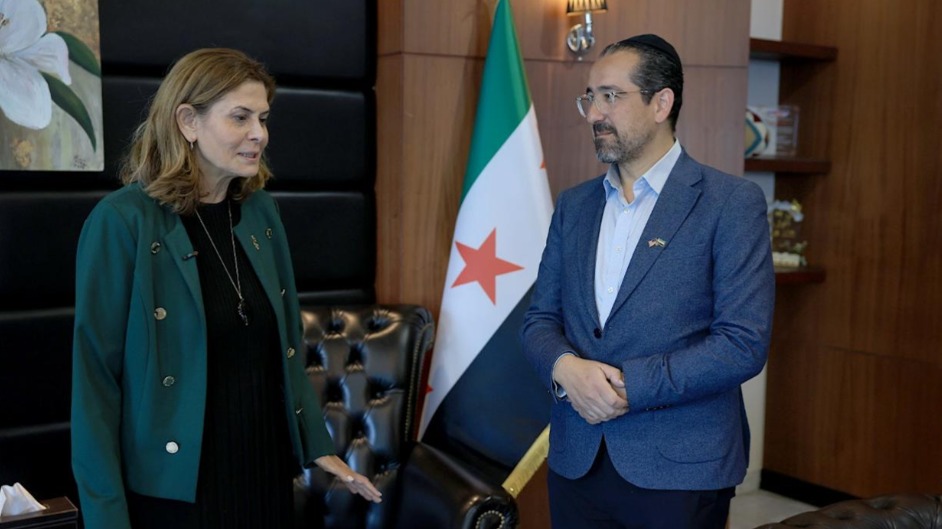
Syria’s post-Assad government dealt a quiet but devastating blow to decades of propaganda on December 10 by formally registering the first Jewish organization in the country’s history and authorizing the restoration of Jewish property and synagogues confiscated under the Assads.
The announcement of the launch of the Jewish Heritage in Syria Foundation, delivered by Social Affairs Minister Hind Kabawat — a Christian woman— further exposes the bankruptcy of Israel’s long-standing narrative that a free Syria would be an extremist threat. It also smashes the Islamophobic 'War on Terror' lens that for years framed Syrians and Palestinians as inherently suspect, unstable, and undeserving of rights. A pluralist Syria is calmly dismantling that offensive Orientalist tissue of lies in real time.
This reality renders Israel’s familiar claims about “extremism on our northern border” increasingly untenable. Since Assad fell, Israel has carried out more than 600 unprovoked attacks on Syrian territory to date, even as the new government channels its limited resources into rebuilding institutions, safeguarding minority heritage, and encouraging the return of displaced communities — including Syrian Jews. The contrast is not merely political; it is moral. One state is repeatedly violating another’s sovereignty while insisting it is the threatened party. The other is restoring Jewish synagogues under the stewardship of a Christian minister. The narrative does not survive contact with the evidence.
For more than two decades, Western discourse has viewed Syrian and Palestinian aspirations for freedom through the distorting prism of the War on Terror — a worldview that reduced Muslim-majority peoples to a security problem and dismissed their political demands as precursors to violent jihad. Under that toxic fascist-friendly logic, a democratic Syria was unimaginable, and a pluralist Syria was impossible. Yet the government now restoring Jewish heritage sites is the same one that was written off as an inevitable Islamist menace. The Islamophobic assumptions baked into the War on Terror narrative are laid bare: Syrians were denied empathy, denied rights, and denied legitimacy not because of anything they did, but because of who they were. Wednesday's announcement is a quiet act of narrative rebellion — and a public reminder that the real obstacle to pluralism was never the Syrian people, but the stories told about them.
None of this requires pretending that the road ahead is untroubled or that terrorism was never a problem in Syria. It was — and the Assads were central to it. The regime was designated a state sponsor of terrorism from the 1970s up until its collapse, relying for decades on a vast machinery of state terror to maintain power. Dictatorships that rule through fear almost inevitably produce violence in response; Syria was no exception. The victims, however, were overwhelmingly Syrians themselves — activists, civilians, and communities caught between a genocidal state and the extremist groups that flourished in the vacuum its brutality created. Those who survived Assad’s prisons and barrel bombs were later hunted by ISIS, often in the same towns and neighbourhoods. The regime did not even disguise its willingness to use terrorism as leverage: in 2011, Assad’s Grand Mufti, Ahmad Badr al-Din Hassoun, publicly threatened to unleash suicide attacks in the West if foreign powers intervened militarily to support the Syrian opposition. That threat, delivered from the regime’s own pulpit, underlined a truth the War on Terror narrative refused to confront or acknowledge: terrorism in Syria was not the product of a people ‘unfit’ for freedom, but of a dictatorship determined to deny them that freedom at any cost.
This painful history should have clarified beyond a doubt who the victims of violence in Syria actually were. Instead, it was grotesquely distorted to recast those suffering repression or displacement as their authors, with external actors amplifying these distortions to fit their own objectives, just as others have cynically weaponised the Palestinian cause as a fig leaf for their own antisemitism, doubly insulting the already grossly misrepresented and maligned Palestinian people. Thus, both Islamophobia and antisemitism have been used by the far-right to smear and delegitimize Arab demands for dignity, justice and fundamental rights. In choosing to restore, rather than instrumentalise, Syria’s Jewish heritage, Syria’s interim government offers the clearest repudiation yet of such malicious racist distortions.
What emerged in Syria this week is not a calculated gesture for foreign consumption but the early architecture of a new civic identity. By placing Jewish heritage under the protection of a Christian minister in a Muslim-majority nation, the government is signalling that pluralism is not an accessory to state-building but its foundation. This is a deliberate unpicking of the Assad dynasty’s sectarian manipulation, which treated minorities as bargaining chips and the majority as a threat. In its place, the new administration is advancing the radical proposition that every community and sect — Jewish, Christian, Sunni, Shiite, Druze, Alawite — belongs equally to the Syrian story. The restoration of synagogues is only the most visible sign of a broader moral and political shift: a commitment to rebuild Syria on the basis of citizenship rather than fear.
A Syria capable of acknowledging its Jewish past — and inviting that past to have a future — is a Syria that refuses to be confined by the West’s narrow expectations, Israel’s strategic anxieties, or the bigotry that defines them. Post-Assad Syria upends both.
Especially at a time when Europe is drifting further and further to the far-right and violence against Muslims, Jews, and other minorities is rising, Syria’s decision to rebuild on a foundation of pluralism is more than symbolic; it's a reminder that the defence of minority rights is neither Western property nor Western habit. A free Syria has chosen a different path — one rooted in dignity, justice, and coexistence. The rest of the world, facing its own fractures, might quietly consider following.
By Ruth Riegler
Photo: Rabbi Henry Hamra, right, and Syrian Minister of Social Affairs and Labor Hind Kabawat, receive the charter of the newly formed Jewish Heritage Association in Damascus, December 10, 2025